AI Maturity and Readiness Assessment and Strategy
At 2Oaks, we help organizations understand their readiness for AI adoption and chart a clear path forward. Our consultants assess where you stand today across strategy, governance, data, infrastructure, people, and model management. A typical engagement runs six to ten weeks and delivers three concrete artifacts: a written readiness assessment, a prioritized portfolio of AI use cases scored on impact and feasibility, and a phased implementation roadmap with measurable outcomes.
Key Components of Our Service
-
A clear-eyed view of your AI readiness across the dimensions that matter. Our team will:
Assess maturity across seven established AI readiness pillars
Surface skill gaps, change-management needs, and resource constraints
Evaluate data, infrastructure, and governance posture against AI workload requirements
-
Strategic AI adoption starts with the right problems, not the trendiest tools. We help:
Identify the high-value use cases worth pursuing first
Prioritize by business impact, feasibility, and responsible-AI risk
Build a defensible return-on-investment case for each opportunity
-
Clear planning is what turns AI possibilities into funded initiatives. Our experts will:
Develop phased roadmaps with realistic timelines and resource requirements
Define success metrics and evaluation strategies from day one
Establish governance aligned with relevant North American and international regulatory frameworks
-
Leadership alignment determines continual funding. We help:
Design the AI operating model that fits your organization
Translate AI capabilities into concrete business value for executives
Build cost forecasting and chargeback practices for predictable AI spend
Provide ongoing strategic guidance as your AI program evolves
Partner with 2Oaks to move from AI uncertainty to strategic clarity, with a roadmap that positions your organization for measurable success.
AI Maturity and Readiness Assessment and Strategy Technical Brief
-
At 2Oaks Consulting, we assess your organization's preparedness for AI adoption across technology, people, processes, and policy. Our assessment is anchored in Microsoft's seven-pillar AI Readiness Model, paired with hands-on evaluation of your Microsoft Foundry, Azure OpenAI, and Microsoft Purview posture. The output is a clear picture of where you stand today and a practical roadmap for where to go next.
The seven pillars of the AI Readiness Model are:
Business Strategy
AI Governance and Security
Data Foundations
AI Strategy and Experience
Organization and Culture
Infrastructure for AI
Model Management
-
Understanding where you stand today is the foundation for everything that follows. Working pillar by pillar across the Microsoft AI Readiness Model, our team will:
Level-set leadership and technical maturity against each of the seven pillars, surfacing skill gaps, change-management needs, and resource constraints
Evaluate technology infrastructure, data estate quality, and integration readiness for Microsoft Foundry, Azure OpenAI, Azure AI Search, and Microsoft Fabric workloads
Assess your governance posture using Microsoft Purview Data Security Posture Management (DSPM) for AI, sensitivity labels, and Entra ID controls so data-exposure risks are identified before Copilot or custom agents are turned on
-
Strategic AI adoption focuses on real operational problems, not on technology trends. We help:
Identify high-value use cases and map each to the right Azure pattern: Microsoft 365 Copilot extension, Foundry Agent Service, RAG over Azure AI Search, or fine-tuning a foundation model in Microsoft Foundry
Prioritize opportunities based on business impact, technical feasibility, responsible AI risk, and fit with your existing Microsoft 365 and Azure estate
Map use cases to measurable outcomes with a clear build-versus-buy recommendation and a defensible ROI hypothesis for each
-
Clear planning is what turns AI possibilities into funded initiatives. Our experts will:
Develop phased implementation roadmaps with realistic timelines, resource allocation, and Azure landing zone requirements for AI workloads
Define success metrics and evaluation strategies using the Azure AI Evaluation SDK, Foundry observability, and Azure Monitor Application Insights so quality, groundedness, and safety are measured from day one
Establish governance structures and risk-mitigation practices aligned with the Microsoft Responsible AI Standard, Azure AI Content Safety, and relevant North American regulatory frameworks including PIPEDA, Quebec Law 25, OSFI model-risk guidance, and the NIST AI Risk Management Framework
-
Leadership alignment determines continual funding. We help:
Design the AI operating model that fits your organization: Center of Excellence, federated hub-and-spoke, or embedded product teams, with clear roles defined across Data, Platform, Security, and Legal
Translate the capabilities of Microsoft Foundry, Azure OpenAI, and the Microsoft Agent Framework into concrete business value for executive stakeholders
Build the FinOps-for-AI foundation: token and inference cost forecasting, Provisioned Throughput Units (PTU) versus pay-as-you-go trade-offs, and showback or chargeback models so AI spend scales predictably
Address concerns around data residency, cross-border data flows, sovereignty, responsible AI, and organizational change
Provide ongoing strategic guidance as the Azure AI platform and your AI program continue to evolve
-
Partner with 2Oaks to move from AI uncertainty to strategic clarity, with a practical roadmap that positions your organization for measurable success on Azure
Your Questions Answered
What is an AI readiness assessment, and why do it before starting AI projects?
An AI readiness assessment is an objective read on whether your organization can truly deliver value from AI, across strategy, governance, data, infrastructure, people, and model management. It matters because most institutions discover their gaps only after committing to a project, which is when timelines slip and budgets overrun. An estimated 95% of enterprise AI pilots never produce measurable return (MIT), and the ones that succeed usually had their data and governance in order first. Our AI Readiness framework walks through what to check before you launch, with a downloadable checklist.
What does a 2Oaks AI readiness engagement deliver, and how long does it take?
A typical engagement runs six to ten weeks and produces three concrete artifacts: a written readiness assessment across the pillars that matter, a prioritized portfolio of AI use cases scored on impact and feasibility, and a phased implementation roadmap with measurable outcomes. We assess maturity against an established seven-pillar readiness model covering business strategy, governance and security, data foundations, AI strategy and experience, organization and culture, infrastructure, and model management. The point is to leave you with decisions you can fund and defend, rather than a slide deck. You can see where this sits in our wider AI Practice.
How do you decide which AI use cases we should pursue first?
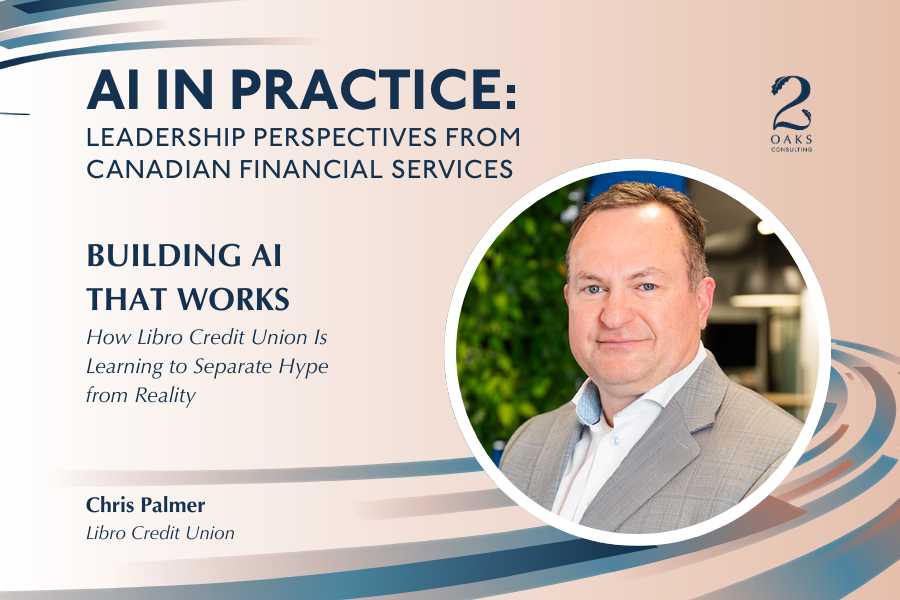
We start from real operational problems where AI measurably reduces cycle time, cost, or risk, rather than from the tools getting the most attention. Each candidate is scored on business impact, technical feasibility, and responsible-AI risk, with a build-versus-buy view and a defensible return-on-investment hypothesis for each. We will also be candidly forthcoming when a use case is not worth the spend. Libro Credit Union's CITO describes this discipline of separating hype from reality in our CIO Spotlight, Building AI That Works.
Do we have to be on Microsoft or Azure to work with you?
No. Our assessment team has particular depth in the Microsoft and Azure stack because that is where many financial institutions have standardized, and we assess your posture there in detail when it applies. The strategy, governance, operating-model, and readiness work stays platform-agnostic on principle, and we adapt to the environment you already run. As a vendor-neutral advisor, we will tell you when the right answer is not a Microsoft answer, or not an AI answer at all, which is the same independence we bring to every engagement on The 2Oaks Difference.
How do you handle AI governance and the regulatory requirements we face?
We've already run an AI pilot that stalled. Can this help us scale responsibly?
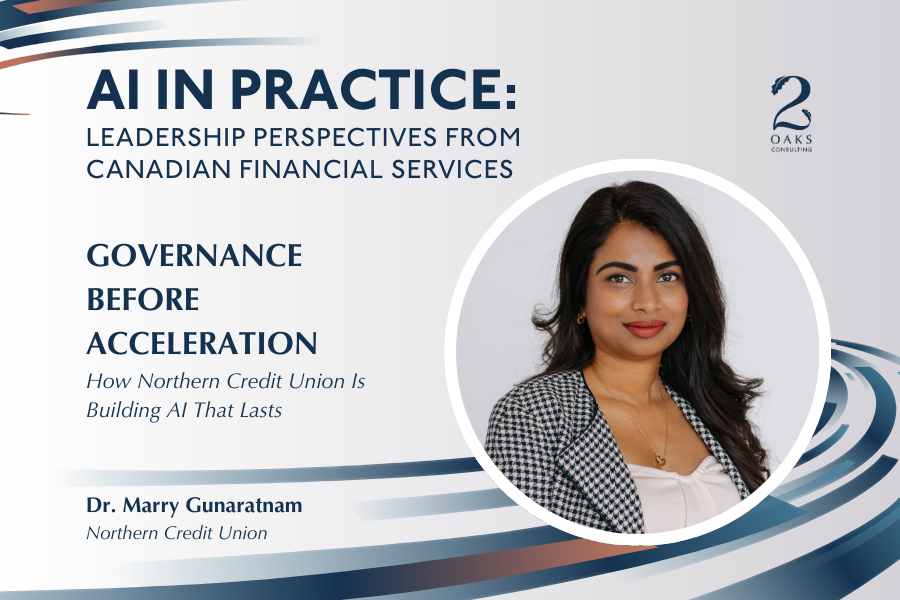
Governance and security are assessed from day one, not bolted on after a pilot is live. For US institutions we start where examiners start: the NIST AI Risk Management Framework, your existing third-party risk program, and fair lending under ECOA and Regulation B, where an adverse action still needs specific principal reasons no matter how complex the model behind it. The harder part is what the rules leave out: in April 2026 the Federal Reserve, OCC, and FDIC replaced the fifteen-year-old SR 11-7 (now SR 26-2) and put generative and agentic AI expressly outside its scope, so your traditional models are covered but your Copilot and agents are not, which is a gap rather than a permission slip. NCUA took the same line in its January 2026 supervisory priorities, naming AI oversight as an examiner focus while folding it into vendor management, fair lending, and BSA/AML rather than a separate rule. Canada is moving the other way: OSFI's Guideline E-23, finalized in September 2025 and effective May 2027, expressly brings AI and machine-learning models into model-risk scope, while PIPEDA and Quebec's Law 25 govern the data underneath. So the burden of proof sits with you, and we surface data-exposure risks before Copilot or agents are switched on and build the AI inventory and explainability record your board and examiner will both ask for, so "the vendor's model did it" is never the answer you are left giving. Northern Credit Union's governance-first approach illustrates this in our CIO Spotlight, Governance Before Acceleration.
Yes, and it is one of the most common reasons institutions call us. A stalled pilot is usually a readiness problem (data, governance, or an operating model that was never set up to scale) rather than a tooling problem, and the assessment is designed to find exactly that. The roadmap then sequences the work to move from a single pilot to production without repeating the mistakes that stalled the first one. From there, our AI Implementation and Pilot Programs service takes the prioritized use cases into production, engineered to ship rather than get re-engineered six months later.
Explore Other Services
-
![A man in a suit is presenting data on a large digital screen at night, with graphs and charts visible.]()
AI Software Archeology
-
![Two people in formal business suits shaking hands in a conference room with digital charts on a screen in the background.]()
AI Data Management and Analytics
-
![]()
AI-Accelerated Modernization
-
![]()
AI Implementation and Pilot Programs
-
![]()
AI Adoption and Organizational Change