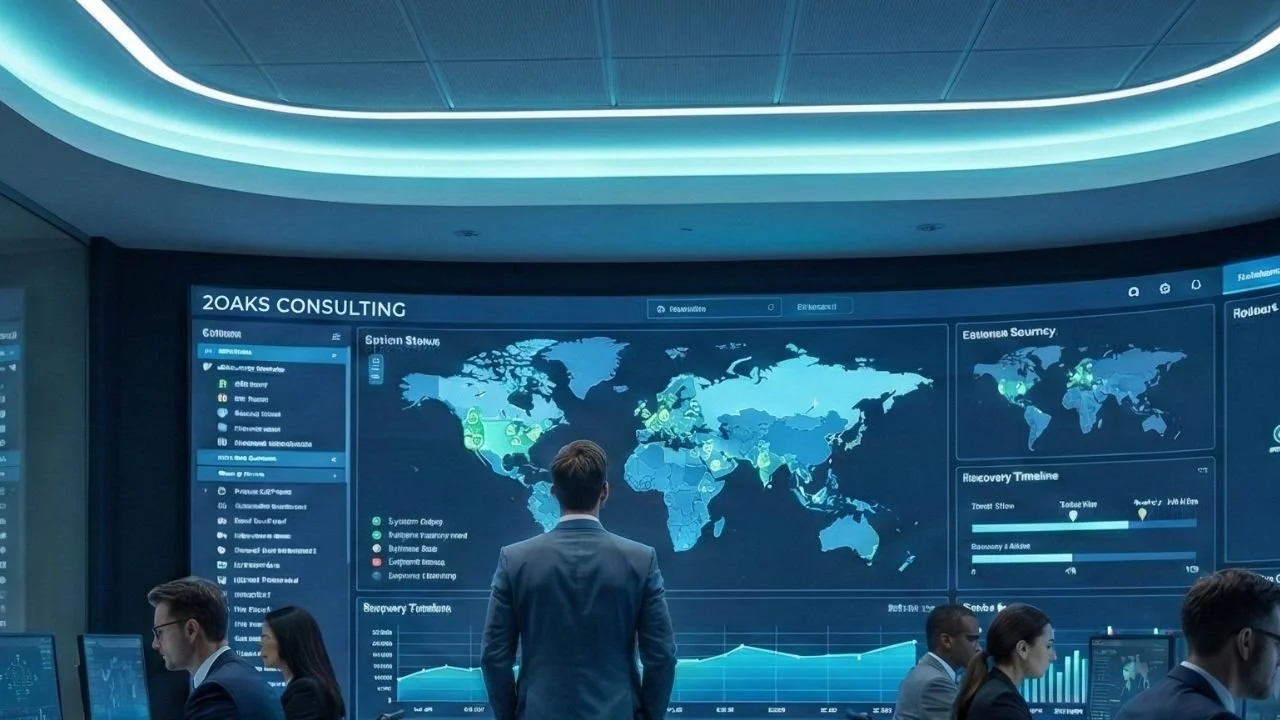
Executive Technology Advisory Service
At 2Oaks, we provide vendor-neutral executive technology advisory for leaders at financial institutions across North America. When you are facing a specific, high-stakes technology decision, a system selection, a major vendor contract, a modernization roadmap, or a board question you need answered, we bring senior, unbiased guidance from people who have sat in the chair, then step back once the decision is made. We work for you, not the vendors, so the advice is the product. If what you need is an ongoing technology leader rather than help with a single decision, our Virtual (Fractional) CIO service fills that seat.
Key Components of Our Service
-
When you are choosing or replacing a system, the decision has to fit your architecture and long-term strategy, not just this quarter's need. Our team collaborates closely with your organization to:
Conduct comprehensive assessments of existing systems and identify critical gaps
Recommend solutions aligned with business goals and architectural requirements
Guide technology investment decisions that support long-term strategic vision
-
Navigating complex technology contracts can be daunting, and vendors negotiate them for a living. Our experts provide contract advisory services, helping you to:
Negotiate favorable terms while ensuring alignment with operational needs and budget constraints
Understand licensing agreements and contractual obligations
Develop risk mitigation strategies and establish clear performance metrics
-
Implementing new technology often requires organizational buy-in. We are with you every step of the way to:
Design and execute comprehensive change management and communication strategies
Facilitate stakeholder engagement and alignment across all organizational levels
Ensure smooth transition and widespread adoption through training programs and employee support
-
Effective project management is essential. We help:
Structure efficient workstreams and resource allocation frameworks
Develop realistic budgets that account for both immediate and long-term needs
Create detailed implementation timelines that minimize operational disruption
-
A clear roadmap keeps a specific investment aligned with where the business is going. We work with you to:
Develop strategic technology roadmaps aligned with business objectives and industry trends
Identify and evaluate emerging technologies for potential competitive advantage
Create frameworks for continuous innovation and system enhancement
Bring us in for the decision in front of you. Contact us to talk it through with a practitioner, not a pitch deck.
Your Questions Answered
When should we use Executive Technology Advisory rather than a Virtual CIO?
Advisory is for a specific decision or initiative with a clear start and end: a system selection, a major contract, a roadmap, or a board question. We bring senior, vendor-neutral judgment, then step away once it is resolved. A Virtual (Fractional) CIO is the opposite shape, an ongoing, embedded leader who runs your technology function, budget, and operating model over time, often when you do not have a CIO or are between hires. Many financial institutions across the US and Canada start with an advisory engagement on one pressing decision and move to a vCIO relationship later, or the reverse. If you are not sure which fits, we will tell you plainly, including when the answer is neither. Our Virtual (Fractional) CIO service covers the ongoing option.
We already have a CIO and an IT team. What does an outside advisor add?
A second set of senior eyes with no stake in the outcome. Your CIO owns the function; we bring independent, vendor-neutral challenge on a specific decision, plus depth in the calls a team may face only once a decade, such as a core selection, a large licensing negotiation, or a modernization sequence. We work alongside your people rather than around them, so the decision is stronger and your team keeps the knowledge. Boards at banks and credit unions in both the US and Canada increasingly expect an independent review of material technology investments before they approve them. You can see how we work alongside internal teams on The 2Oaks Difference.
Can you give us an independent second opinion before we commit to a vendor or a business case?
Yes, and it is one of the most common reasons executives bring us in. We pressure-test the recommendation, the assumptions, and the numbers, and because we take no referral fees and hold no preferred-vendor ties, our read reflects what fits you rather than what suits a supplier. Where the case is sound we say so; where it is not, you find out before you sign rather than after. That documented, independent review also helps your board show it did proper diligence, which regulators on both sides of the border look for on major technology spend. You can see what clients say about that on our Customer Testimonials page.
How do you help us make a technology decision that will hold up with our regulator and our board?
We build the regulatory test into the decision rather than bolting it on afterward. For Canadian institutions that means aligning with OSFI's expectations, including B-13 on technology and architecture governance, B-10 on third-party risk, and E-23 on model risk where AI or models are involved. For US institutions it means the FFIEC IT Examination Handbook, the 2023 interagency guidance on third-party relationships (Federal Reserve, OCC, and FDIC), and NCUA's vendor-oversight expectations for credit unions. In both markets we leave you with the documented rationale, the options assessed, and the risk analysis a board or an examiner will ask to see. You can meet the practitioners behind that on Meet Our Team.
How is an advisory engagement scoped, and how long does it run?
What kinds of technology decisions do you advise on?
To the decision in front of you. Most engagements are a fixed-scope sprint focused on a single question, a system selection, a contract review, or a roadmap, running weeks rather than months, with a clear deliverable and a defined end. You deal directly with partners and practice leads, so you are not funding a bench of junior analysts, and the cost is a fraction of a full-time executive hire. If the work reveals that you need ongoing leadership rather than a one-off decision, we will say so and point you to the Virtual (Fractional) CIO service.
The high-stakes, infrequent ones where getting it wrong is expensive. Common examples include selecting or replacing a core or major platform, negotiating a large vendor or cloud contract, sequencing a multi-year modernization roadmap, deciding whether to build, buy, insource, or outsource, and framing a board-level AI strategy grounded in governance rather than a vendor shortlist. We work with banks, credit unions, insurers, and wealth firms across the US and Canada. For how we think about one of those calls, see our guide to Insourcing vs. Outsourcing IT Operations.
Explore Other Services
-
![Two colleagues, a woman and a man, work together in a modern office at night, leaning over a conference table with papers, a laptop, and coffee cups, surrounded by colorful sticky notes on the glass walls.]()
Enterprise Architecture and Strategy Roadmapping
-
![Business professionals shaking hands in front of digital graphs and charts displayed on large screens.]()
Mergers and Acquisitions
-
![]()
Business Continuity Planning
-
![]()
Executive Technology Advisory Service
-
![]()
AI Maturity and Readiness Assessment and Strategy
-
![]()
Virtual (Fractional) CIO